Intro
Imagine flipping through the pages of a coloring book, your fingers itching to bring the designs to life. The choices before you are many: colored pencils, watercolor pencils, and—perhaps surprisingly—wax crayons. While the latter might raise a few eyebrows, it prompts an interesting question. Have we unfairly boxed wax crayons into the realm of childhood?
Most of us have memories of scribbling with wax crayons as children. They were our trusty companions—affordable, resilient, and always vibrant. But as adults, we often dismiss them, thinking of them as imprecise and unsophisticated. But could we be missing out on some genuine fun and relaxation by sidelining them?
The Grayscale Adventure
My journey took me to grayscale images, specifically those with a traveling theme, conveniently taken from my own coloring book. And if there’s any place to experiment and risk making a mess, it’s within the pages of my own creation. But would coloring these iconic sites only remind me of past adventures, or spark a strong desire to travel again?
Grayscale images, in my opinion, have an advantage. They already provide the natural shades and shadows, reducing the pressure on the colorist. Even with a limited palette of fewer than 20 crayon shades for my experiment, achieving magic is still feasible.
Vivid Colors
Wax crayons undoubtedly conjure images of vibrant and rich colors. The innate saturation they bring to a piece can vivify any drawing, offering a palette that’s as dynamic as it is bold. While I acknowledge that the potential for layering is somewhat limited, especially if the paper lacks a grainy texture, a bit of experimentation opens up the possibility of creating a range of shades by overlaying different colors. It’s through these trials and the occasional mistake that I’ve come to truly understand and appreciate the scope and limitations of wax crayons.
On a side note, when discussing coloring mediums with a waxy base, some might bring up the phenomenon of ‘wax bloom’. While this is more commonly associated with high-wax-content colored pencils, it can indeed appear with wax crayons as well. Wax bloom manifests as a cloudy, white film on the surface of the artwork, caused by the wax rising to the top. Not all crayons, however, will show this trait prominently, and the appearance can vary based on factors like brand, technique, and paper type. If you do encounter wax bloom, whether with crayons or colored pencils, a simple solution is to lightly buff the surface with a soft cloth or tissue. Alternatively, you can use a fixative spray to seal and protect the artwork, preventing further bloom.
The Precision Paradox
The real challenge with wax crayons is that they aren’t as precise as fine-tipped coloring pencils. My first mistake, and admittedly a silly one, was during my initial attempts when I overlooked a fundamental step—sharpening the crayon! Considering how often I sharpen colored pencils, it might seem like an obvious move. However, I missed this simple yet transformative step in the beginning.
That being said, even with a sharpened tip, wax crayons inherently produce a bolder stroke compared to fine-tipped coloring pencils. This, however, can also be seen as their strength. They facilitate rapid filling, lending an unfiltered and raw touch to the artwork. The spontaneity and boldness of crayons can indeed be invigorating!
The Blend Game
The beauty of wax crayons can truly be unveiled when you start blending. However, unblended crayon strokes can look patchy. When blended, these colors flow seamlessly, producing a stunning image. The caveat? Blending demands a solvent. In my quest, I used odorless mineral spirit. Although it’s labeled ‘odorless,’ it carries similar health risks as turpentine, which is something users should be mindful of. While there are other blending options available, my journey centered around this particular solvent.
Conclusion
The verdict on wax crayons? They held their ground impressively. The end results were delightful, echoing raw emotions and spontaneity. While I thoroughly enjoyed the process, the blending phase, especially the necessity of using solvents, didn’t sit entirely well with me. For now, I might stick to my colored pencils for most projects and reserve solvents for my oil painting adventures.
After much experimentation with wax crayons, I’d love to share with you some of the projects I tackled. These range from the grandeur of the Big Ben, the timeless allure of the Eiffel Tower, the ancient mystique of Stonehenge, to the breathtaking expanse of a forest landscape illuminated by northern lights, and the iconic Statue of Liberty. Each piece presented its own set of challenges and joys, but if I had to pick a personal favorite, there’s something about the Eiffel Tower piece that truly resonates with me. Perhaps it’s the intricate lattice structure or the romantic aura that Paris exudes; either way, it holds a special place in my heart.
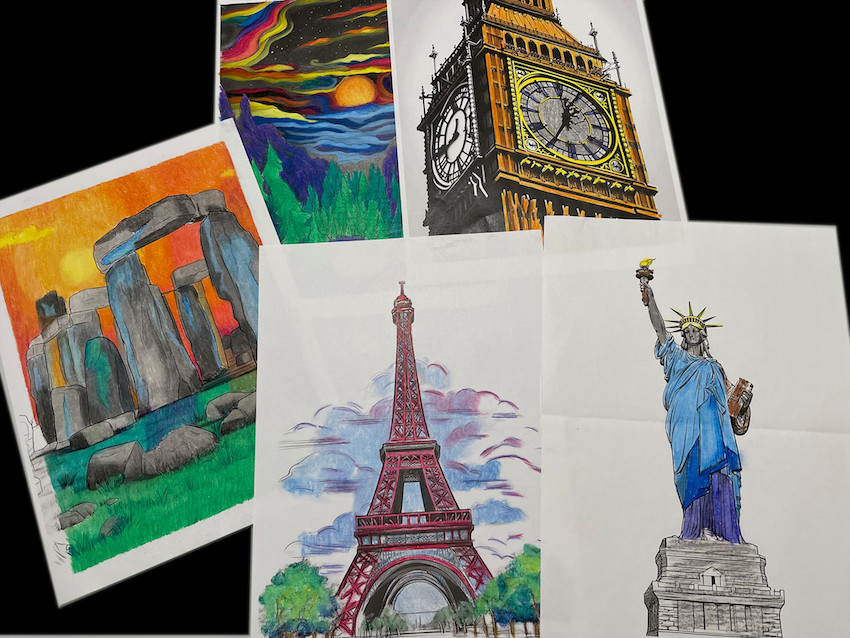
If you’re curious to watch my coloring process, feel free to check out my wax crayon playlist. I’d be thrilled if you joined me on this colorful journey!

 Artistic Adventures with Victoria
Leave a comment