Writing a book, developing the plot with all its twists and turns, and creating characters who grow and change is something I find familiar and enjoyable. However, there’s one step that has always seemed daunting to me: marketing.
I’m curious about the performance of my books, but without marketing, I won’t get any insights. Amazon’s basic analytics don’t provide information on the visibility of my books; they don’t even show if anyone has looked at them. Of course, I can see the sales report, but that’s not enough.
The Options
So, how should I get started? The dream scenario is: someone sees your book, buys it, and reviews it. This might have happened organically in the past, but I doubt that’s the case today. I could be wrong, though.
So, what are the options?
I could upload the ebook to my website to be downloaded free of charge and ask for a review if the reader feels inclined. They might or might not do so. I actually tried this; I offered the books for free download and asked for reviews. I got a few downloads and a few reviews. I’m very grateful to those who reviewed the book! At least someone read it and went the extra mile to post a review. However, most people didn’t leave a review. I don’t know if they disliked the book or just didn’t find it necessary to leave feedback.
There are also websites where you can join (for a fee, of course) to get reviews. It’s unclear to me how the reviewers get the books. This kind of service might explain why some “interesting” books have surprisingly good reviews. There’s an ethical side to review shopping, and Amazon policies don’t allow it. This feels like buying followers on YouTube—not okay.
The third option is to use Amazon ads. This is what I chose to try.
The Experiment
I decided to create an advertising campaign with a tiny budget and bids. The campaign lasted about two weeks for the children’s storybook and one week for the coloring book. If you know nothing about Amazon ads, each click costs the sum I bid. To get visibility, I need to bid higher than the competition. This doesn’t guarantee a sale; a click only means someone saw the ad and clicked on it. Optimal placement is, of course, the first page.
I wasn’t able to see the ad for the children’s book, but I did manage to find it for the coloring book. I didn’t click it myself, though. But this is what the ad looked like.
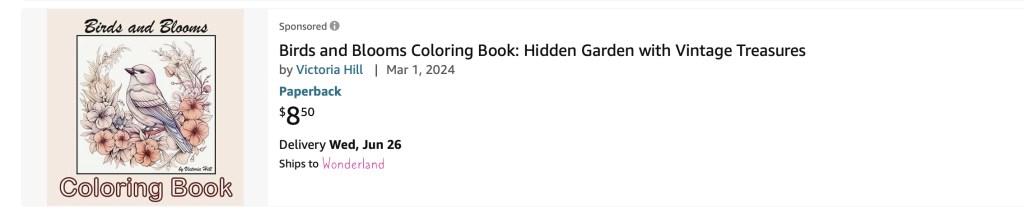
The campaigns have ended, and I have the results. For the Alexia and Phoebe story, I got 999 views but not a single click. For the coloring book, I got 118 views and 1 click. I still don’t know how to read the reports about the placement of the ad or the keywords.
Final Thoughts
What was my goal? To get visibility for my books and convert that to reviews. I know some people advertise for a long time, but I don’t see how that’s feasible if you compare the bids to the profit per book. But my tactic was different; I never meant to continue the campaign for a long time. I was after the reviews and the organic growth that would come with them.
What did I learn from this test? It was interesting to see that I could make bids that gave my books visibility. But what did the stats tell me? Do you think 1000 impressions are good or bad? For the coloring book, I got maybe 3 or 4 impressions in the first few days. Compared to the children’s book, that was low, so I ended up increasing my bid. I didn’t touch the daily budget, though.
To get a reference point, I researched this subject a bit on YouTube. Why wouldn’t I trust a random YouTuber for advice? Besides videos claiming I could make tens of thousands of dollars with print-on-demand products, I found one channel that said, typically, a book needs to be viewed 250 times to get a click and 2500 times to sell one copy. These are huge numbers from my perspective and would require a much higher budget.


 Artistic Adventures with Victoria
Leave a comment