As a lifelong Jane Austen reader, I find it fascinating to ask: how much can Pride and Prejudice bend before it breaks?
We live in an age of Austen reinventions. A new adaptation of Pride and Prejudice is on the way, The Other Bennet Sister is about to become a movie, and readers can’t seem to get enough of reimaginings. Some retellings add zombies, some shift the timeline, and others tell the story from a minor character’s perspective. Austen’s world seems strong enough to take it all.
But what if the story isn’t as unbreakable as it seems?
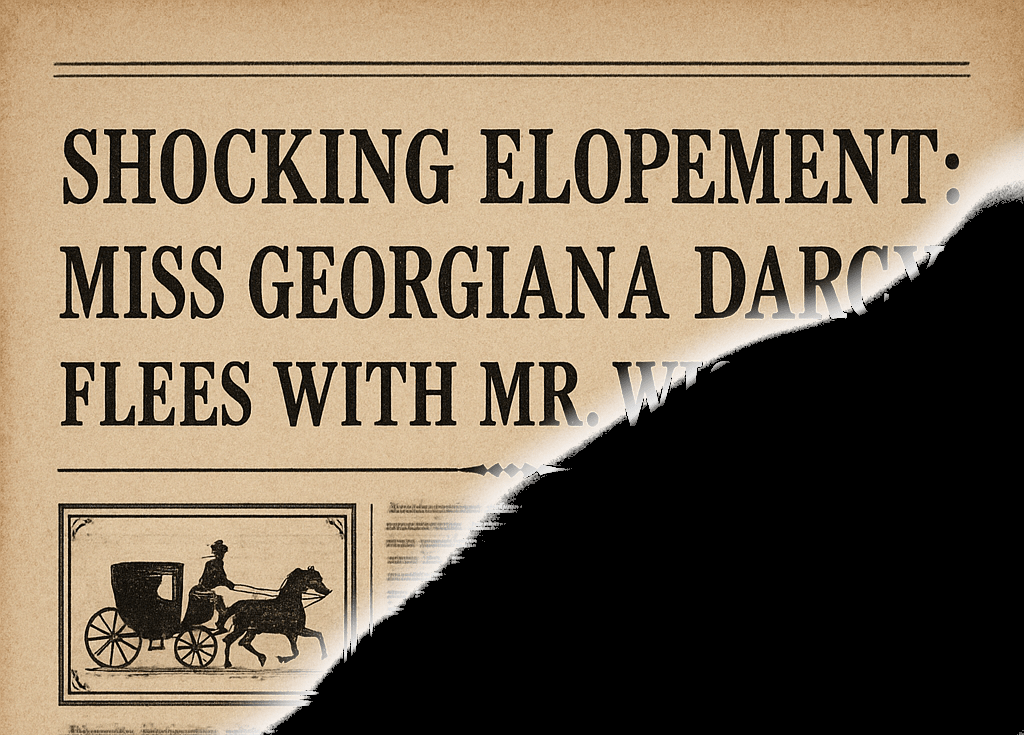
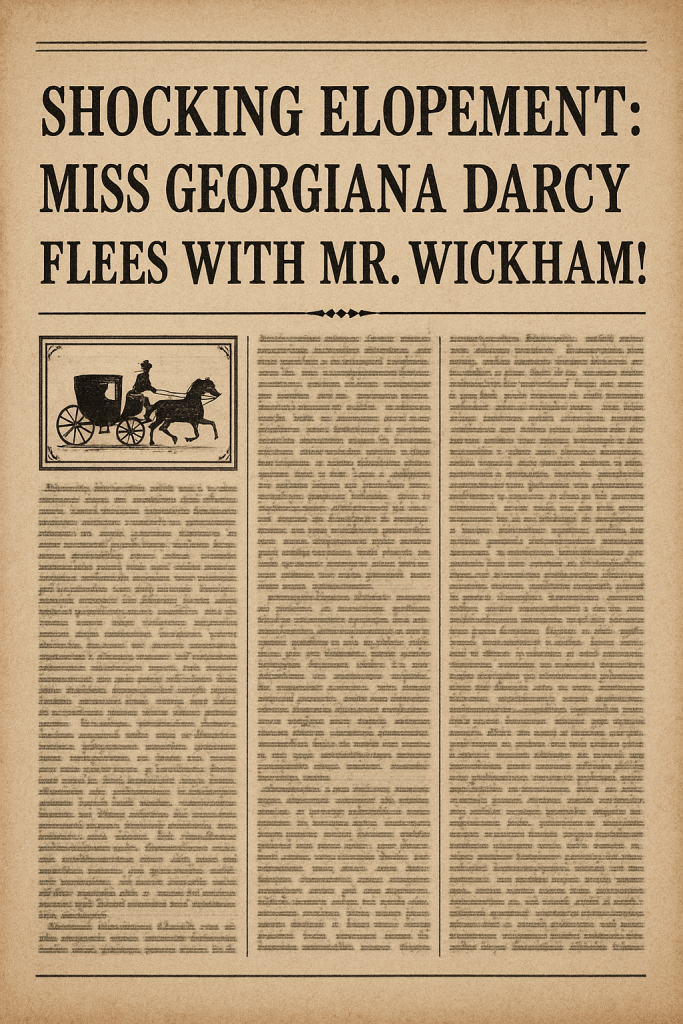
Recently, I played with one single change: what if Mr. Darcy’s younger sister, Georgiana, actually did elope with Wickham?
In Austen’s novel, Darcy prevents the scandal just in time. It becomes a piece of backstory, something he reveals to Elizabeth in his famous letter. But imagine if he had failed.
Suddenly, the dynamic of the story changes: Darcy does not arrive in Hertfordshire with the Bingleys. Even someone of Darcy’s high social standing would suffer from being the brother of a ruined girl, and the Bingleys, anxious to protect their own place in society, would hardly risk bringing such scandal into their circle. Though Bingley himself, warm and loyal, might wish to stand by his friend, his sisters would consider it essential to preserve distance, lest they too should suffer by association.
Without Darcy’s quiet influence, nothing hinders the progress of Bingley’s regard for Jane Bennet. Their mutual affection, obvious to all but the most determined skeptic, would naturally deepen into an attachment that could not easily be shaken. Caroline Bingley and Mrs. Hurst, though unwilling to approve such a connection, would find themselves powerless to prevent it. Their objections, unsupported by Darcy’s authority, could only take the form of sharp remarks and wounded airs.
So, in this version, Jane and Mr. Bingley would find happiness much faster. But what would happen to Elizabeth? Could she find happiness with Mr. Collins? I think not. Jane would have been out of reach the whole time, and Mr. Collins would have quickly turned his intentions to Elizabeth. She, of course, would have refused him (why would she have replied otherwise?), and Mr. Collins would have made his offer to Charlotte Lucas, who would have accepted. Thus he would have considered himself “the happiest of men.”
And then, what about Mr. Darcy and his aunt, Lady Catherine? Would Lady Catherine, in this altered tale, waste no opportunity to advance her wish — the marriage of her daughter Anne to her nephew as the obvious solution to restore family honor — or would she utterly distance her family from Georgiana’s disgrace? Either way, I do not think it would change the outcome, for I do not see this as a match. Mr. Darcy might withdraw from society rather than parade his shame, working quietly behind the scenes to settle accounts, protect Georgiana as best he could, and manage the scandal with all the resources at his disposal.
And what of Elizabeth and Darcy themselves? Could there still be a match? In this altered tale, their paths might never truly cross. Without Darcy at the Meryton assembly, Elizabeth’s first impressions are formed not by his proud silence but by the scandal of his sister. If they did meet later, perhaps at Rosings, it would be under the weight of Lady Catherine’s claims and Darcy’s own withdrawal from society. Their exchanges would lack the spark of courtship, taking instead the shape of cautious conversation and mutual observation. Elizabeth might come to see in Darcy not the proud man she once dismissed, but a figure marked by duty and misfortune. Respect, perhaps even admiration, might grow between them — but romance, I think not.
In the end, this simple alteration — Georgiana Darcy eloping with Wickham — is enough to undo the whole story of Pride and Prejudice.
So — what do you think? Could you still love a Pride and Prejudice where Georgiana ran off with Wickham? Or did I miss something in my experiment?




 Artistic Adventures with Victoria
Leave a comment