A Thought Experiment in Breaking Austen’s Masterpiece
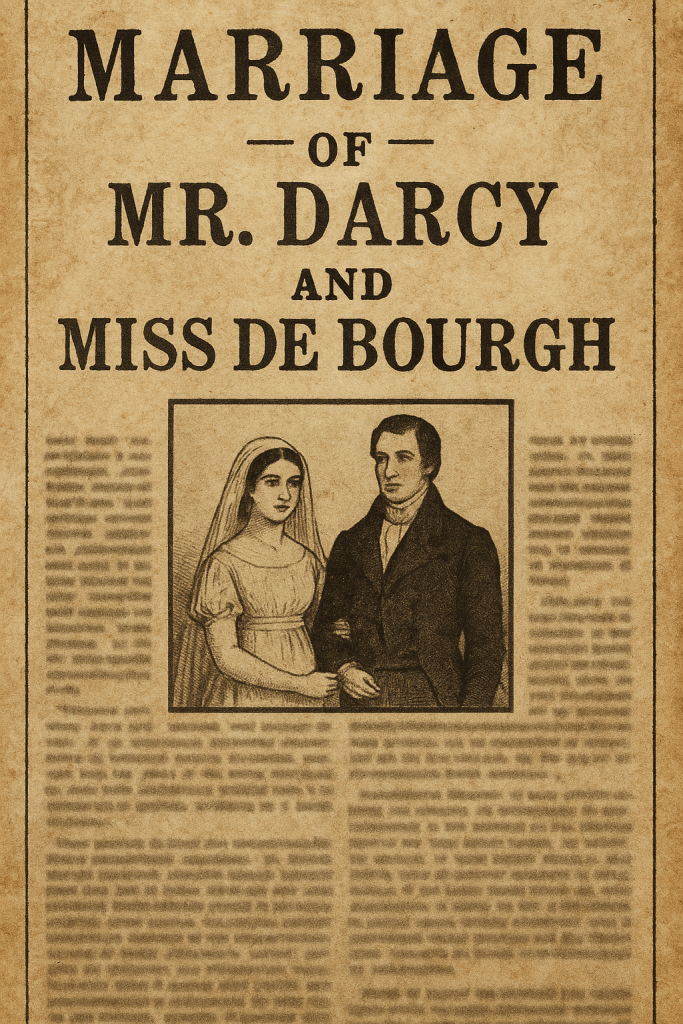
What if Pride and Prejudice were not a story about love at all, but about duty? In the Regency world, this would hardly have been unusual. Many marriages were arranged or encouraged for practical reasons — property, lineage, social connection — and the idea that marriage should be based on love is, historically speaking, a relatively modern concept.
This time, my question was a simple one: what would make Mr. Darcy marry Miss de Bourgh? Could a small alteration in Austen’s original story lead to this happy event?
Let us begin with what we know. The proposed match is driven, of course, by Lady Catherine — but not by her alone. As she herself reminds us, “It was the favourite wish of his mother, as well as of hers.” Suppose we take that statement at face value, not merely as Lady Catherine’s interpretation. Could the marriage have taken place if Mrs. Darcy had not died so young? Would it have been more difficult for Darcy to ignore his mother’s wishes if she were still present to insist upon them?
And if that is not enough to convince you, let us imagine a more dramatic scenario: Mrs. Darcy on her deathbed, speaking to her son with her final breath.
“Fitzwilliam,” said his mother, in a voice low yet perfectly distinct, “there is a wish which I must not carry with me unspoken. You are not ignorant of the affection which has long subsisted between your aunt and myself, nor of the hope, cherished by us both, that you and her daughter, Anne, might one day be united. Such an alliance, my dear son, would ensure to Pemberley and to Rosings a stability and distinction that neither could secure alone.”
Darcy inclined his head in silence. The proposal was not new to him; but never before had it been urged with an earnestness which seemed to invest it with the authority of a dying command. To hear it thus, so solemnly, and from lips whose entreaties were soon to cease for ever, was to feel its claim as sacred.
“Mother,” he said, after a moment’s pause, his voice betraying more agitation than he intended, “your wishes shall ever possess a weight with me which nothing can diminish.”
A faint expression of contentment softened her countenance, and she pressed his hand with feeble affection. At that instant the door was opened, and Lady Catherine entered, her step resolute and her air triumphant; for she discerned, with all the quickness of family vanity, that her sister’s influence had at last effected what years of her own persuasion had failed to accomplish.
Would that not make the marriage almost inevitable?
Another reason might be wealth — or the lack of it. If both of Darcy’s parents were still alive and managing the estate, he would never have become master of Pemberley so young. Without the independence and authority that early inheritance gave him, he might also lack the wealth and confidence that allow him to choose freely. In such a circumstance, the prospect of uniting Pemberley and Rosings through marriage might appeal to him far more.
And so, by the time Mr. Bingley arrives at Netherfield, Darcy would already be married — happy or not, but married nonetheless. Perhaps he would still accompany his friend to Hertfordshire. Perhaps he would not. Either way, the Darcy who enters the Bennets’ world would be a very different man: bound not by love but by duty, his life’s most important choice already behind him.
And before I finish — a small addition. I am well aware that the internet is full of advice warning writers to stay away from the em dash, claiming that its overuse is the surest sign of AI-written text. And yet, here we are — and here it is. I happen to like the em dash — it is dramatic, slightly unruly, and wonderfully useful when a comma just won’t do. So I shall keep it — proudly — and trust that readers will know there is a human behind these words.


 Artistic Adventures with Victoria
Leave a comment